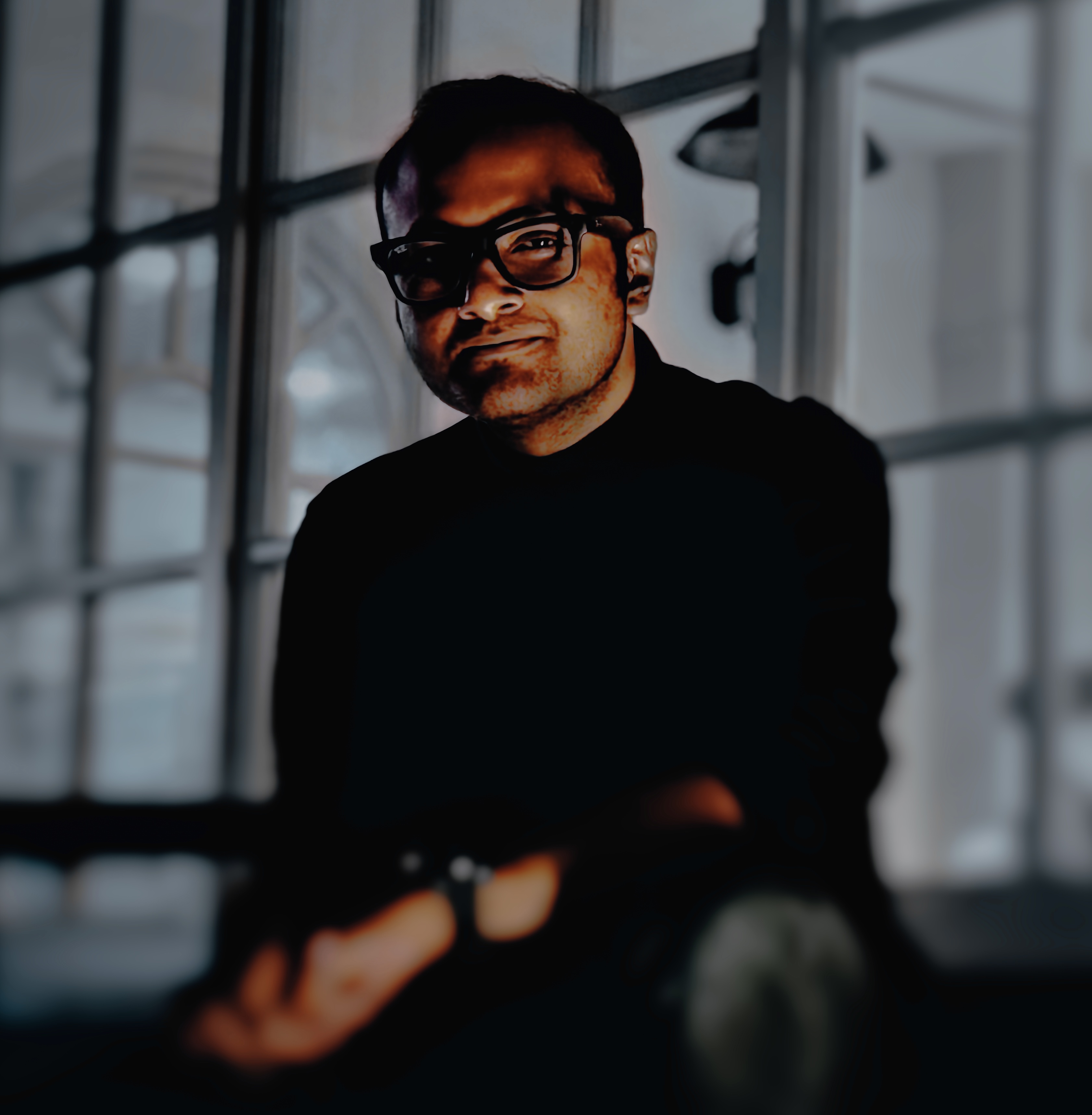
Karan Chandra Dey

Artist & Media Technologist — 6 years

Software Engineer — 4 years

AI in Healthcare / Creative Technology / Art & Design

Media Artist & Creative Technologist Interactive AI Experiences & Data Art Human × Machine

I've always been more interested in the gap than the thing itself. The gap between a body moving through space and a machine trying to understand what that movement means. The gap between a dataset about human life expectancy and the actual human life it is trying to describe. The gap between what a camera sees and what a person feels standing in front of it.

That gap is where I build.

K28.

what drives
this

I'm not trying to make technology beautiful. I'm trying to make it honest.

We live inside systems that watch us, model us, predict us — and yet we rarely get to feel what that actually is. I want to make the invisible relationship between human presence and machine perception into something you can stand in front of and feel in your body.

What does it mean to be witnessed?
Can a system be built with empathy?
If data is made from human lives, does it carry something of those lives inside it?

I don't have answers. The artworks are the attempt.

K28.

the
medium

I work with computer vision, machine learning, generative AI, p5.js, Processing, JavaScript — not as ends in themselves but as a specific kind of material with specific properties.

Code has no weight, no texture, no smell. But it has behaviour. And behaviour, when carefully tuned to respond to human presence in real time, begins to feel like attention.

The artwork pays attention to you — to your movement, your proximity, the pace of your gestures — and it responds. Not with an answer. With a shift. Something that says: I noticed.

K28.

what the
work explores

My works move across different themes — mortality, wellbeing, perception, the body, memory. They all share the same underlying concern: what happens to meaning when it passes through a machine?

Behind every life expectancy statistic is an enormous, irreducible human reality. When I translate that data into something reactive — something you stand in front of and influence with your presence — something different becomes possible. Not understanding. Something closer to reckoning.

K28.

what i've
built

Real-time systems — your body becomes the instrument that shapes the visual world. The piece doesn't run without you.

Data visualisations — global health statistics that respond to human presence, making inequality something felt rather than read.

Generative systems — machine learning models that evolve across a session, genuinely shaped by the interaction.

Atmospheric works — emotional signals drive living visual environments with no fixed state.

K28.

living
systems

The works have no static version. They are defined entirely by their behaviour over time, in response to whoever is present. Remove the viewer and the work is incomplete.

The artist designs the conditions under which something can happen — and then steps back. The viewer completes it. Every time differently.

K28.

a realistic
note

I'm not interested in technology as spectacle. The most dangerous thing in this space is the artwork that dazzles with its capability and leaves you feeling nothing.

The works on this site are the ones where something real happened, even briefly, between a person and a machine. That's enough. That's the whole project.

System initializing...
Requires Presence.

Designer and AI builder working at the intersection of UI/UX, creative technology, and healthcare.

Over the past year, I've focused on a single practical question: what can one person build with AI tools, without a large team or budget? The short answer is — quite a lot, if you work with the right approach.

What I build:

An interactive healthcare dashboard using real US public datasets — visualizing demographic, regional, and EHR data in a way that's clean and clinically informative

An iOS app prototype for tracking daily water intake relative to body weight, with smart reminders based on actual shortfall

AI implementation frameworks grounded in primary research, designed for individuals and teams adopting GenAI practically

Interactive AI artworks using computer vision and gesture recognition — built on research linking meaningful art engagement to measurable wellbeing outcomes

Where I'm focused now:

AI and healthcare — specifically how generative AI can improve clinical workflows, patient outcomes, and community-level access to care. This is a natural convergence of design thinking, AI capability, and a domain where the stakes are real.

How I work with clients:

I work 1-on-1 with individuals and teams to cut through the noise and apply AI to their specific context — whether that's rebuilding a workflow, prototyping an idea, or developing the practical skills to use these tools well.

Tools and technologies:
Computer vision · Machine learning · Generative AI · p5.js · Processing · JavaScript · UI/UX design · AI strategy